So, we went on this extra little trip. Just Berlin, Germany and Prague, Czech Republic. We wanted to see Prague before it became too westernized.
We flew into Berlin and took the train to Prague the next day. I had a great time on that train ride. We were in a compartment with a retired German couple, who were from the former East Germany. Thus, they had not been schooled in English. His knowledge of English was "How do you do?" It was a great opportunity for me to exercise my German, and I had fun doing so. It was one of my most favorite people-meeting experiences, and I wish I had gotten their mailing address. From the conversation, I found out that they originally thought we were Swedes. Apparently, we are not the typical loud Americans, and this surprised them.
Dobry den Praha. I can't really speak Czech at all. It has a lot of
similarities to Polish and some with German. It didn't matter, because
everyone we met in Prague was multilingual, and very good at it too. I
witnessed one lady switch from conversing with one couple in Italian (I think),
to another in German, and to us in English. Her English was a better than that
of many Americans I've met.
We arrived in the early afternoon, so we had that and the first evening to mosey around town. They have the same setup with the metro system as most European cities seem to have. You can buy a day pass that works the buses, trolleys, and the subway. We bought the five day pass, even though we were only going to be there for one and a half. It cost about three dollars. And we got checked by the same transit cop twice.
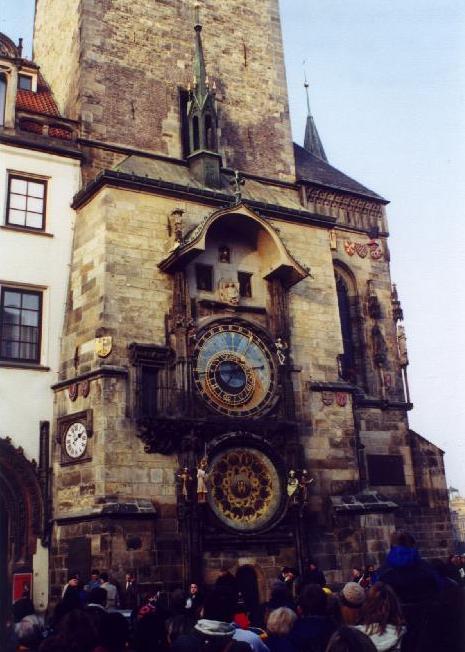
This is the Astronomical Clock in Prague. It tells the time in three different systems. On the hour, the figures around the clock move. The skeleton on the right side pulls a string which rings a bell to count the hours. There are figures of the twelve apostles, who rotate through the two open windows above the upper dial. It tells time in our 24 hour system, some old Roman system with twenty divisions in a day, and a Babylonian system. The Babylonian system is curious, in that it divides the period of daylight into twelve equal parts, so the length of an hour changes during the course of a year. It also shows what signs of the Zodiac the Sun and Moon are in currently.
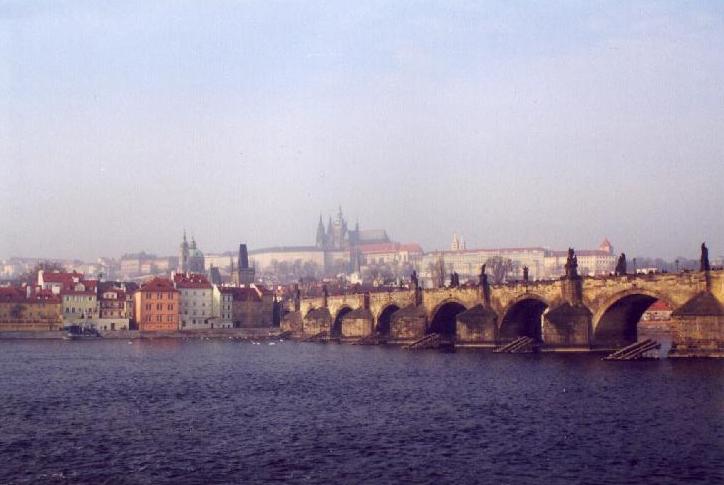
The Charles Bridge. A pedestrian bridge with statues and where street vendors
abound. It connects the Old Town, on the near side of the river, to the Little
Quarter, on the far side. On the hill in the background is the Prague Castle
complex, containing one huge cathedral (St. Vitus), a monestery (St. George),
a bunch of smaller chapels, the Old Palace (where the Defenstration of Prague
took place in 1618), the New Palace (where the current government operates
from), and a bunch of other museums and buildings we didn't have time to get
to.
One unfortunate thing about Prague is the haze. Because of pollution levels in the area, there is a permanent haze in Prague in the wintertime. This shot was taken on a "clear" day. This haze is really evident in the night pictures, see the night picture of town hall.
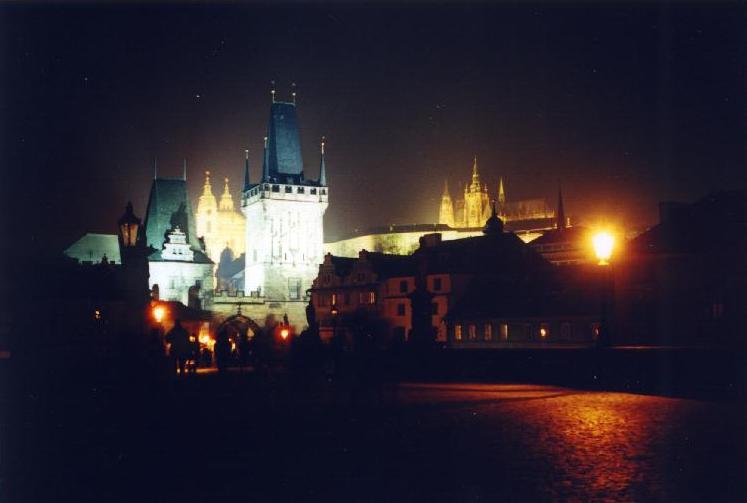
A shot taken from on the Charles Bridge at night. This is the western tower
of the bridge with the Prague Castle in the background. Even late into the
night, there were musicians and vendors, and lots of couples in the shadows.
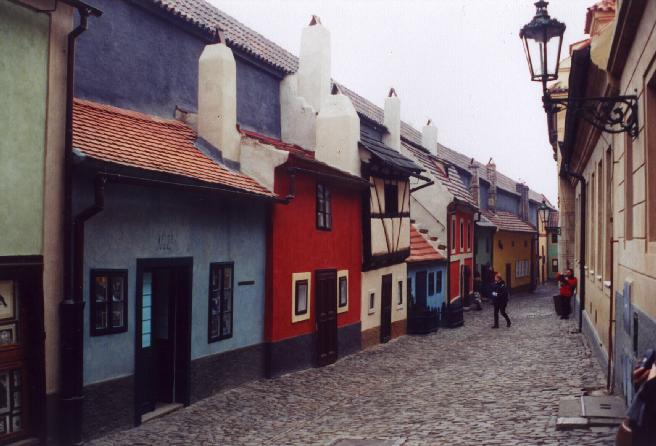
The Golden Lane of Prague Castle. These are little houses that were built
for the castle defenders. I don't know if they were originally so
brightly colored. Now, they're full of trinket shops.
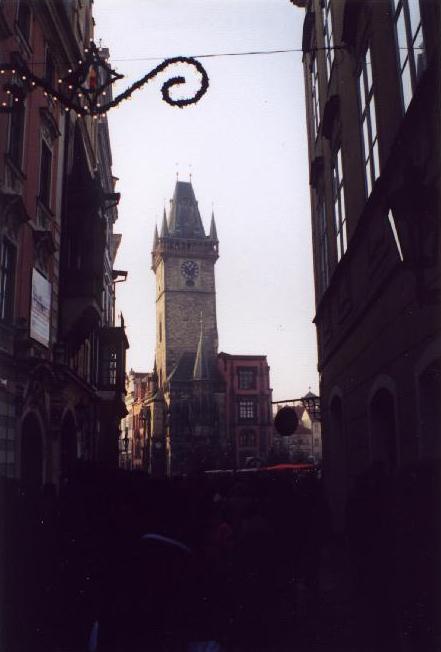
This is the Town Hall in the Old Town section of the city. We happened to
catch a Christmas market in the town square. They had setup tents and stands
and were selling seasonal things. They even had a merry-go-round, with real
ponies. A lot of clothing and crystal vendors.
There are a lot of towers in Prague, and you can go up them, during the summer. I was bummed by this, but luckily, the Town Hall tower was open all year. So, we went up and took in the view of the city. It was a real tiny catwalk around the top, and it was packed with people.
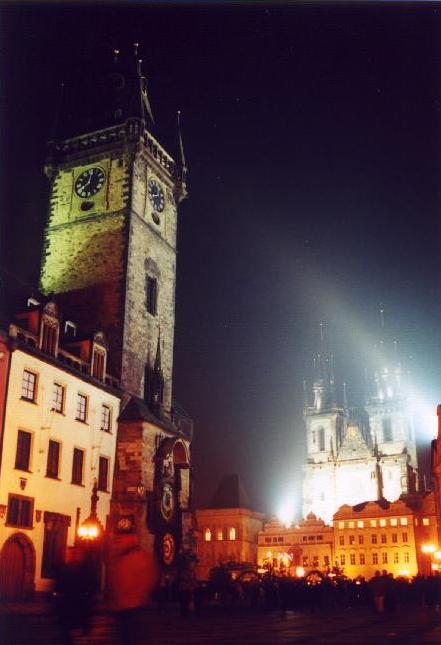
This is a night photo of Town Hall on the left, and the Tyn Church on the
right. You can see the Astronomical Clock on the side of the Town Hall.
The famous Danish astronomer, Tycho Brahe, is entombed in Tyn, but we couldn't
locate him. The church is undergoing restoration on the inside.
Tycho Brahe, 1546-1601, made an impressive catalog of over 1000 stars, studied the motions of the planets, studied the moon and comets, and mentored a young Johannes Kepler.
This concluded our adventures in Prage. A nice town, but getting over commercialized. Catering to tourists is fine, I guess, but I found the planet Hollywood and TGI Friday's right in the middle of things to be a little much. At least the McDonald's in Salzburg tried to blend into the town. Anyway, the next morning we were back on the train to Berlin.
Guten Morgen, Berlin.
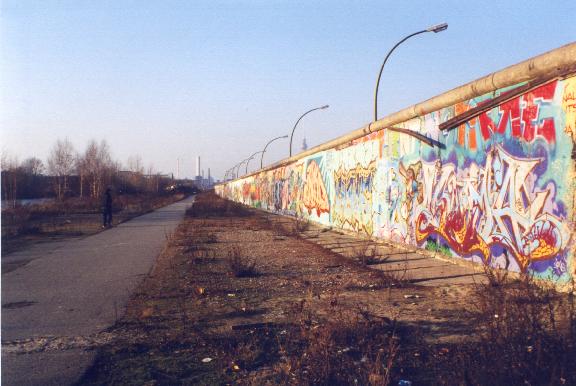 We had to hunt for it, but we managed to find a section of the Berlin Wall
still standing. This had ringed the entire land access to the city, 140km
of it. This picture was taken from the western side. Immediately on the other
side would have been an empty strip of land filled with antipersonnel mines
and barbed wire. Beyond that there was the system of guard towers, and anyone
caught trying to get over the wall was shot.
We had to hunt for it, but we managed to find a section of the Berlin Wall
still standing. This had ringed the entire land access to the city, 140km
of it. This picture was taken from the western side. Immediately on the other
side would have been an empty strip of land filled with antipersonnel mines
and barbed wire. Beyond that there was the system of guard towers, and anyone
caught trying to get over the wall was shot.
The guards were members of the East German defense forces, vigilantly defending their (facade of a) Marxist state against incursion of the western capitalists. The guards were rotated so that no two served together more than once. This was to prevent escape plans from being developed, since you didn't know the other guy and couldn't gauge his loyalty.
It is situation that is difficult to fully grasp without having been there when the wall was active. Berlin was an occupied city for over 40 years after the end of World War II, and West Berlin was was walled in to keep the eastern Germans from escaping to the west through it. Kinda weird, having people trying to escape INTO an encircled and closed in city.
I visited West Berlin as a child, and besides being horribly sick with chickenpox, the wall left quite an impression on me. The wall really defined the political climate during my childhood, and in that respect I am rather sentimental about it. But, it was a huge psychological detriment to the German citizens and had to go. So, I'm happy and sad. I honestly never thought I would live long enough to see it come down. Further information about the wall can be found at http://www.wall-berlin.org/ and http://www.dailysoft.de/berlinwall/index_en.html and http://soleil.acomp.usf.edu/~abutel1/index.html.
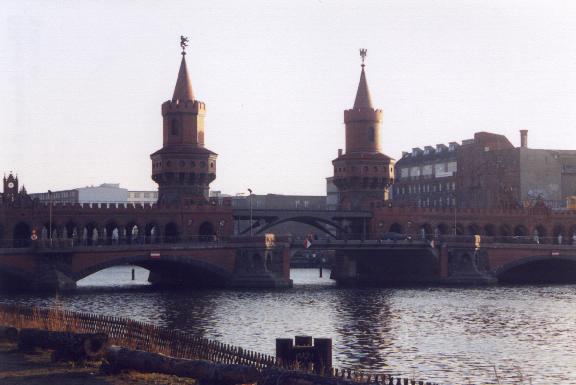
This was a neat bridge over the river Spree, the Oberbaumbrücke. There is
the roadway, and a pedestrian way, and on top, the metro rail. I understand
that this was one of the intersector crossing points for Germans. There
were spots where the "wall" ran through the river. In these cases it became
more of a grate with pointy needles, instead of a wall, but the point of it
was the same, to keep people from crossing the barrier.
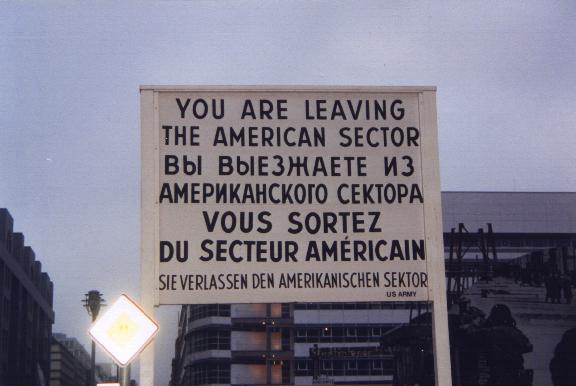
This is what's left of Checkpoint Charlie. Actually, this sign is a reproduction.
This is where foreign nationals were required to present papers when passing
from West Berlin into East Berlin. This is the setting for many a spy novel.
U.S. and Soviet tanks came really close to shooting at one another here.
The last of the Eastern guardhouses can barely be seen underneath the sign
across the street. The American guardhouse is gone, having been relocated
to the Allied Museum.
There is an interesting museum near here, dedicated to the wall and
those who tried to clamber over it. Many of whom were shot in the process.
The area is being rebuilt as a business campus named after the checkpoint, although it has little resemblance and only a geographic connection to the way things were. You'd think they would have left something standing, but no, just a sign. My comment is to remind everyone of the quote "Those who forget history are doomed to repeat it."
(As a followup, I understand that they have built a reconstruction of the U.S. checkpoint building on the site since my visit. Interestingly enough, the final active checkpoint listed all three western allies, the reconstruction seems to only list the U.S. as was the case in the 1960's.)
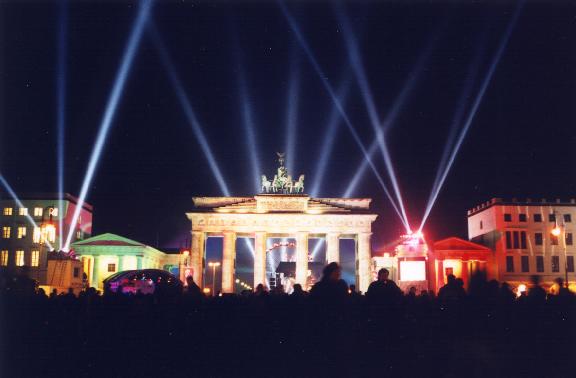
I shot this photo at the New Year's Eve celebration at the Brandenburg Gate
in Berlin. What a fun evening. I felt kinda like a jet-setter, "Oh, yes,
we just jaunted off to Berlin for New Year's." And it was friggin cold
out there. Just the way I like it. It was 20 degrees Fahrenheit, and one hotel
had setup a bar outside... made completely of ice. We stayed out there for
about four hours.
Every last German seemed to have a backpack full of fireworks and champagne. And they shot corks and explosives everywhere. Parents were teaching their kids how to light them and drop them in trashcans. Several phone booths were blown to bits that night. From what I could glean from the news the next day, only one person had been reported to be injured. But, the revellers sure kept the fire department busy.
What made this evening even more significant for me, was that when I was in Berlin eighteen years before, I would have been arrested for being where this picture was taken, and I certainly would not have been allowed to walk through the gate. This was in the Soviet sector, on the east side of the gate.