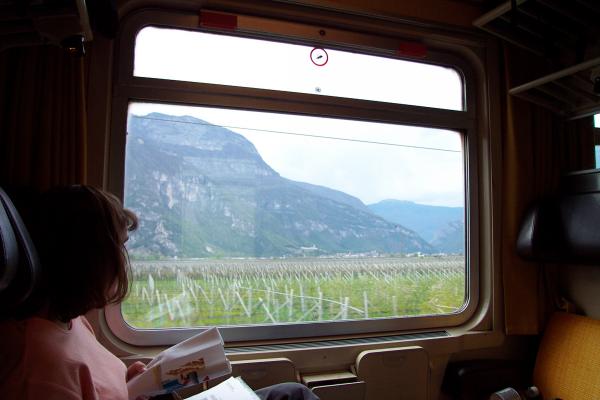
We added a side trip to Venice after the airplane tickets had been purchased. So, we arrived in Munich,
and promptly got on the train for Venice. It was very easy and convenient, as
Deutsche Bahn has a desk
in the airport terminal, and booked us all the way through to Venice's Santa Lucia station.
 Things could have been easier, if it weren't for stupid USAir. They overbooked
the Philadelphia to Munich flight, and not by a small amount. We volunteered to yield our seats if they
would put us on the flight to Rome, which would have still left us with a train ride, but added a chance to
see that city. But no, they told us there wasn't time to get our luggage out of our plane. Hello? So
what about the folks that you wound up paying $800 to stay in the airport hotel until the next day? You got their luggage out.
I really do not like flying USAir.
Things could have been easier, if it weren't for stupid USAir. They overbooked
the Philadelphia to Munich flight, and not by a small amount. We volunteered to yield our seats if they
would put us on the flight to Rome, which would have still left us with a train ride, but added a chance to
see that city. But no, they told us there wasn't time to get our luggage out of our plane. Hello? So
what about the folks that you wound up paying $800 to stay in the airport hotel until the next day? You got their luggage out.
I really do not like flying USAir.
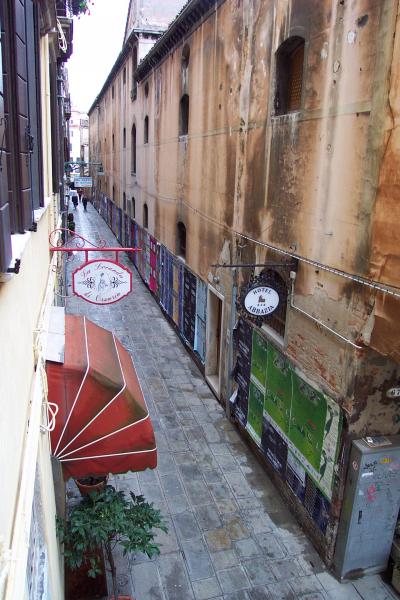
So, tired and bedraggled, and with heavy suitcases, we arrived in Venice and checked into our hotel,
La Locanda di Orsaria. A nice, cozy hotel. I wanted
something close to the train station, so we didn't have to lug the luggage that far. This charming
place was located in an alley near the station, but with enough buildings in between, that you didn't
hear the trains coming and going. However, for the proximity, the hotel cost more than others further
into town. Still, it was a good night's sleep.
I was in Venice years ago in the early 1980's. My lasting memory of the place is that it stunk.
It was quite the olfactory assault. Things were different this time. Except for one canal that
had been drained for maintenance, the odor was happily absent. The town also
seemed a lot cleaner.
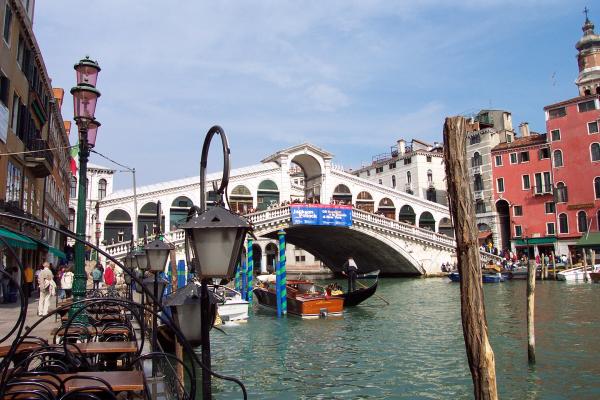
The Rialto, one of Venice's two main attractions. Also one of only three bridges across
the Grand Canal. Lined with souvenir shops on the inside, take the outside walkway. The
view is much better.
We are still wandering about, making our way to the centerpiece of Venice, the Piazza San Marco.
This is in the more upscale shopping area to the east of the Rialto.
I stopped into a music shop here, looking for a CD of that type of music that makes you
think of Italy and Venice, with mandolins and accordions. It was a pointless struggle. I didn't
know the Italian words for what I was looking for, and they didn't understand the English words
I was using to describe it. Instead, I found a CD after I got home,
Dinner in Italy, which embodies
the mood I was looking for.
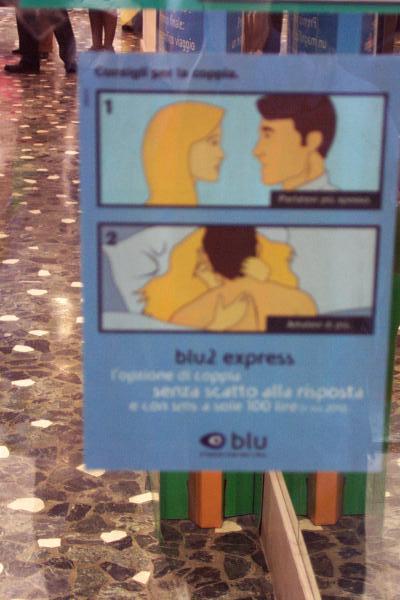
I wish I had gotten a better picture of this advertisement, so I could get the Italian
translated. It was in the window of a cellphone store. As near as I can tell, it seems
that if you mention their product, you'll get to home base with the other gender.
(Update: I found someone else's picture of it on a billboard. I love Europe.)
Finally, Piazza San Marco. This is the spot where tourists gravitate to. There
are outside restaurants all along the square here, many with live music. It's
quite the scene, and quite expensive, I understand. Cheaper to just go a block
off of the square and buy food from a take-away counter, then come back and sit
on a bench. Still, if you want better food, don't eat anywhere near here.
Find something in a cozy back alley somewhere else.
This is Venice's Santa Lucia train station.
The day we were supposed to be on the train back to Munich, the Italian transportation
workers decided to strike. Many of the museums and government offices held a sympathy
strike. Not much left to do other than wander about.
It's absolutely amazing that this kind of technology was able to connect people in large population centers.
I am always awestruck by the engineering involved in applications that do wonders without the
benefit of today's commoditized technology.
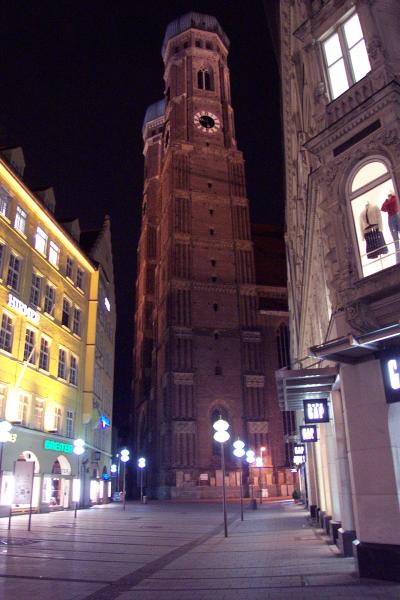
A night shot of the Frauenkircke, Munich's most recognizable portion of the
skyline. The busy downtown area really cleans out after dark. All
of the tourists and shoppers go away. There are plenty of charming restaurants to try out.
It was a busy day in Munich, but now it was time to get some sleep. The hotel we stayed at here was
way out in Schwabing, and an 800m hike from the Alte Heide U Bahn stop. 800m isn't that far
to walk normally, but when you're exhausted and dragging luggage, it is a bit of a pain.
So, we won't mention or link the hotel here.
We picked up a rental car from Sixt, and headed to Nürnberg.
We've used Sixt a couple of times now, and have been rather pleased. But, we neglected to add
a second driver to the lease, and wound up wasting an hour at the airport fixing that. So,
the day in Nürnberg was cut rather short.
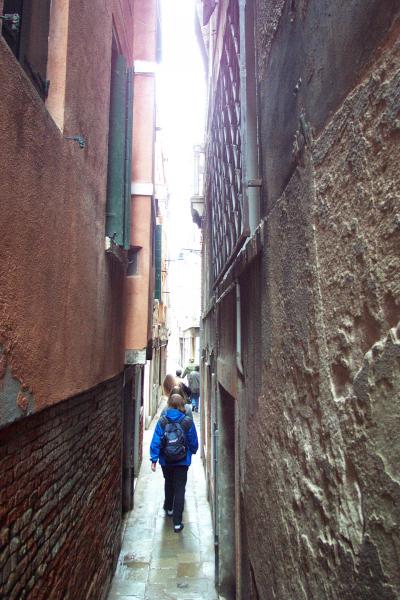
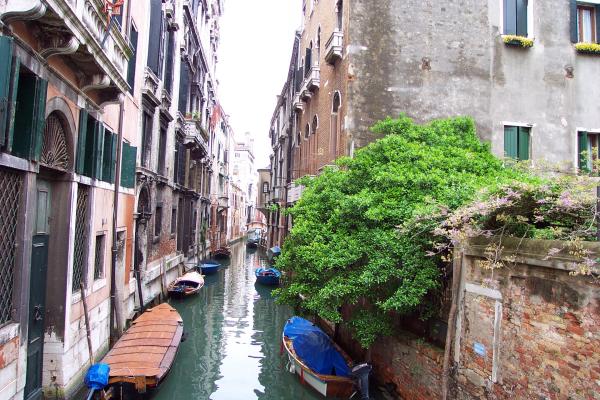
So, rested, we set out to explore this city of winding passages and canals.
There is something neat about following narrow passages, getting lost, and
then turning a corner to find it open out into a small square with a cafe.
Or a mammoth church shoehorned in between blocks of homes, which you can't
see as you approach, and then boom, you see it as you're almost on top of it.
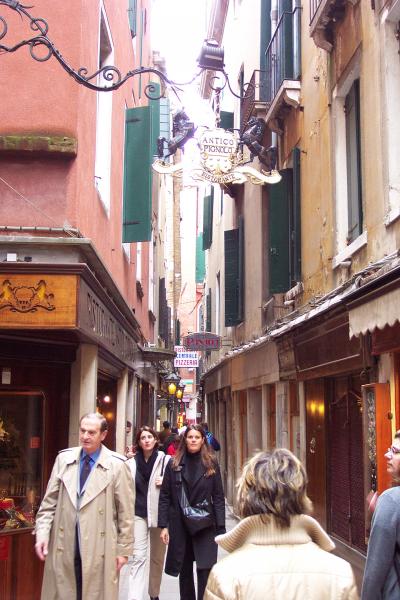
Most of the fun in going anywhere in Venice seems to be the getting
there, navigating all of the little passages and alleyways.
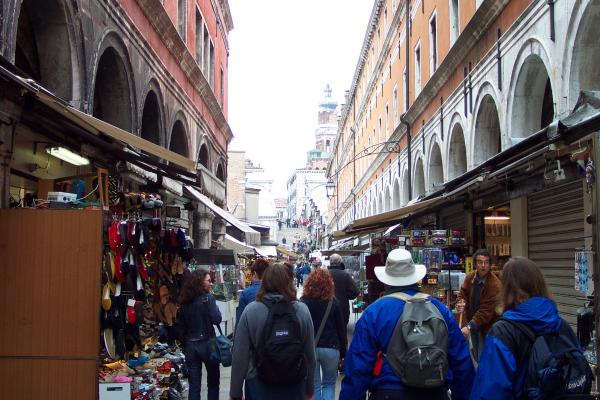
This is the marketplace on the western side of the Rialto. A beehive of activity. I didn't shop
here, so I can't say if there were bargains or if it was a tourist trap. It was fun to wander
through though.
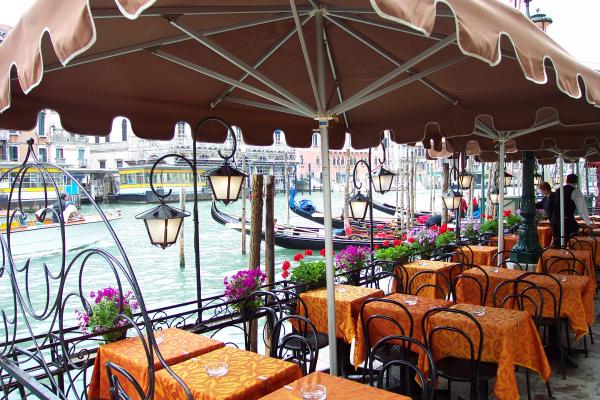
A posh looking eatery right on the Grand Canal. Gondolas docked nearby. Gentle lighting from the
lanterns. Add some accordion music, and you've got the epitome of romantic Venice.
With all that boat
traffic, and other things, in the water, I'd be afraid my meal would get splashed. Maybe that
explains why the tables are all empty.
Still, I imagine this would be a fabulous place to eat in the evening after the bustle dies down.
Note that for the next trip.
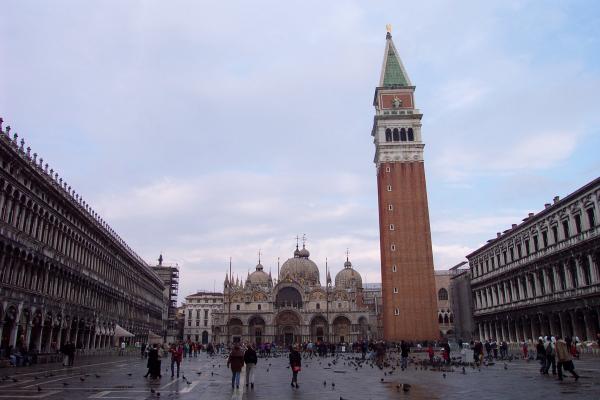
At the far end of the square is the Basilica and the Campanile.
The Campanile, the bell tower, has an observation platform at the bell level.
It has a commanding view of the lagoon, and worth the visit, even if you are
afraid of heights. It actually had collapsed in 1902, miraculously not
killing anyone, and was rebuilt. It feels pretty solid to me now.
Oh, and the bells do chime, which are right above your head while you're on
the observation deck.
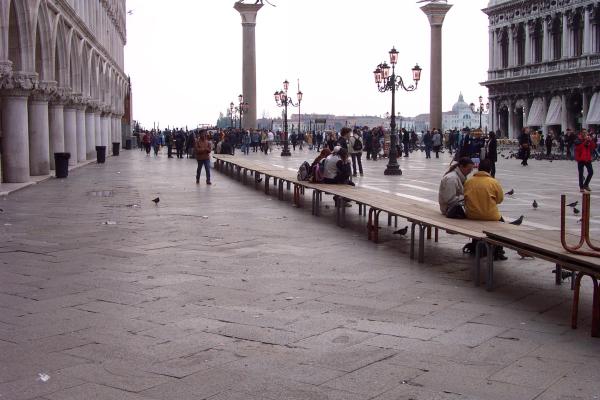
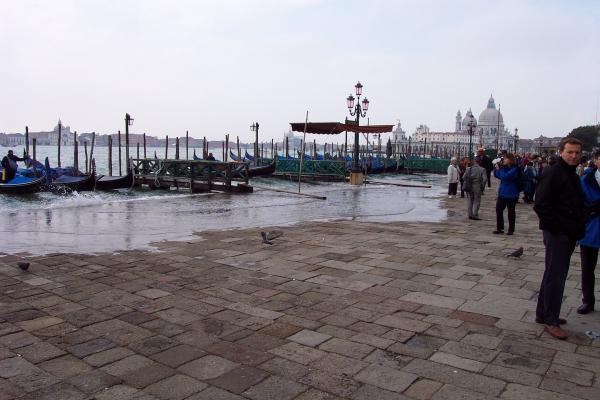
These benches aren't really for folks to sit on. Venice has a problem with high tides,
and these become walkways.
Be it rising water levels or sinking ground levels, water regularly rises up into town.
There has been decades of discussion on what to do about the problem. One of the issues
was the decrease in groundwater underneath the town, as it was being used by the large
petrochemical concerns about the lagoon. This issue has been fixed, so the town isn't
sinking as fast as before. But the tidal surge coming from the Adriatic is still an
issue, and I think Venice will be gone before they agree on a method of dealing with it.
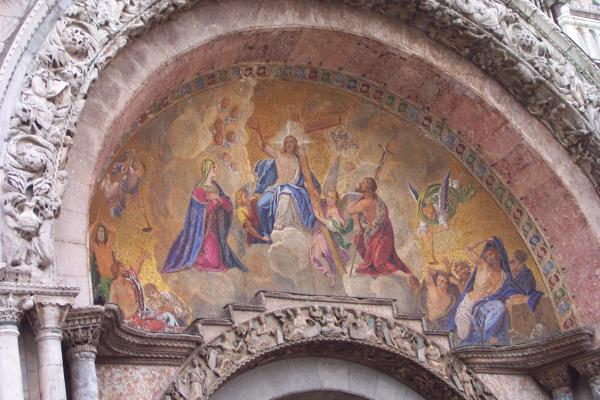
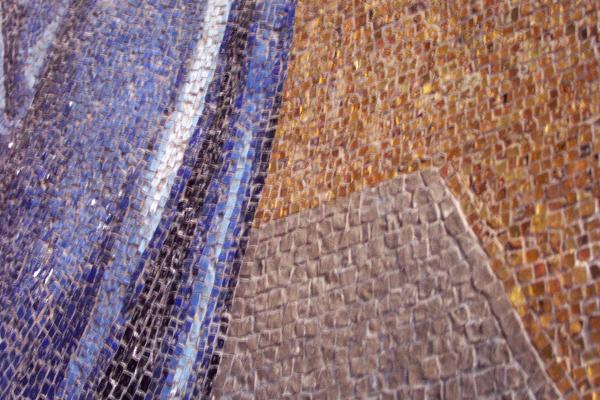
This is one of the mosaics on the front of the Basilica. To the right is a closeup of it.
It is made of thousands of tiny squares of glass with the backside painted. Easy to clean without
damaging the paint.
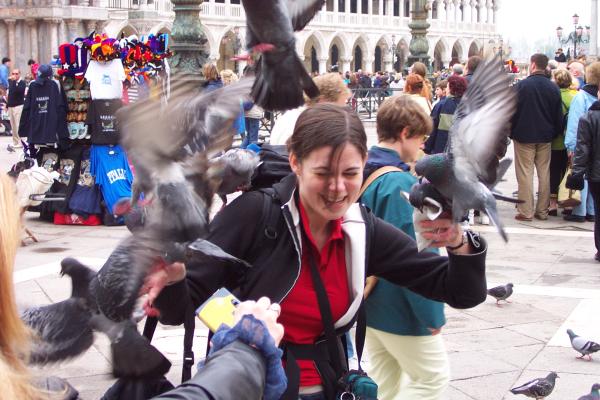
One of the more amusing activities to watch or partake in at the Piazza is feeding some
of the thousands of pigeons that loiter about. Don't hold your hand out unless you intend
to get mugged by a swarm of these feathered bandits.
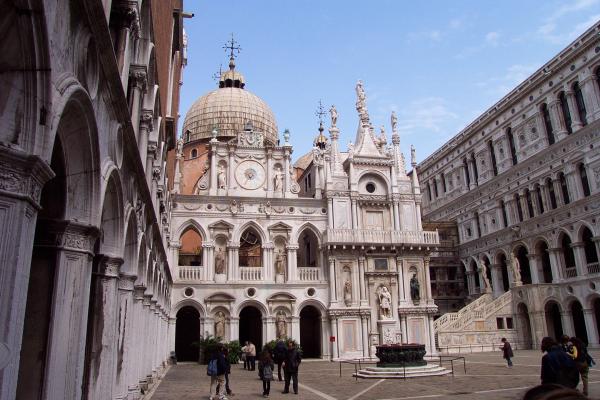
The courtyard of the Doge's Palace. It backs up to the Basilica. Convenient thing to do,
back in those days, when political power and religious authority were closely linked.
This is where the Venetian empire was based. For having as much power and economic influence
as they did, they seem to get very little mention in school history texts, I know my school
books didn't mention them.
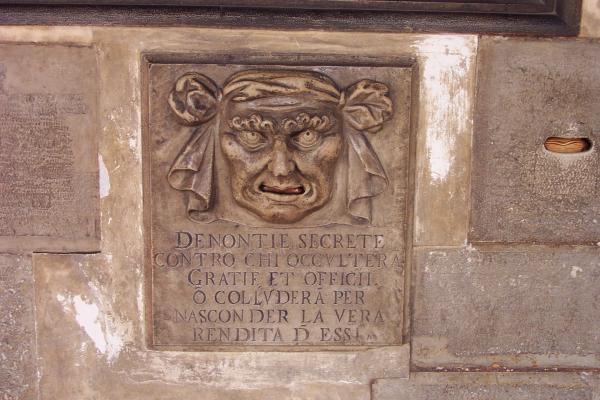
This is one of the infamous "Lion's Mouth" drop boxes about the city. Whenever a citizen
wished to accuse someone of a crime or other wrongdoing, a paper describing the offense
was placed in the mouth. Often, the punishment was quite brutal. And if someone was discovered
to have falsely accused, their punishment was even worse. I'm not sure how they determined
that, since these boxes were supposed to make the accusation anonymous, but that's what
the history books say.
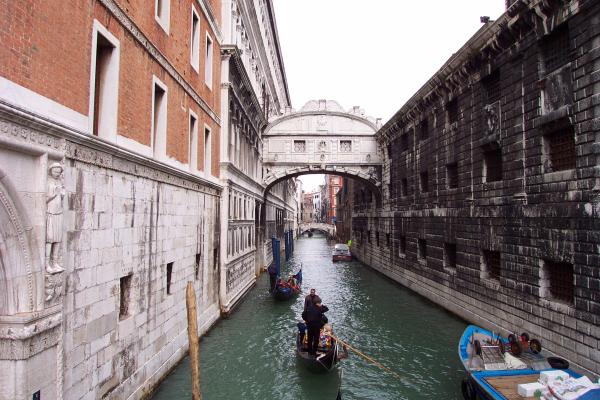
The Bridge of Sighs. This led from the Doge's Palace to the prison. As with most medieval
prisons, this one was not the most pleasant of places. Somehow, though this bridge has
been popularized by the romantics, as Casanova had been imprisioned here. I've heard of folks
proposing marriage on it, under it, and in front of it, although I can think of a hundred more
suitable bridges in Venice, that don't lead to a prison.
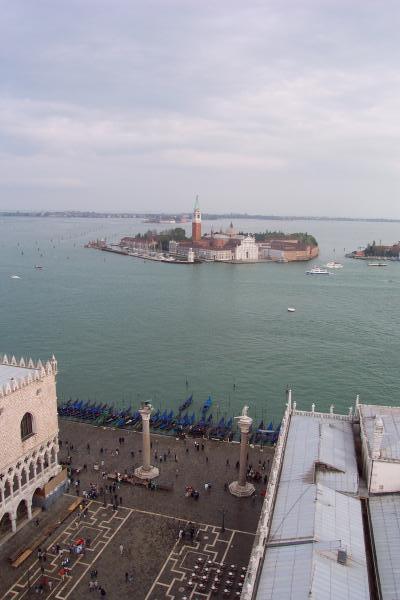
A gorgeous view from the Campenile. You can see the pillars, below in the square, to Saints
Anthony and Mark, one with a (???) on it, the other with a Winged Lion. Much lore surrounds the
moving of St. Mark's remain from Egypt to Venice, with much significance placed on it being
biblical destiny. The short end of it really is that the Venicians stole the remians, ousted
their old parton saint, and then tried to justify it.
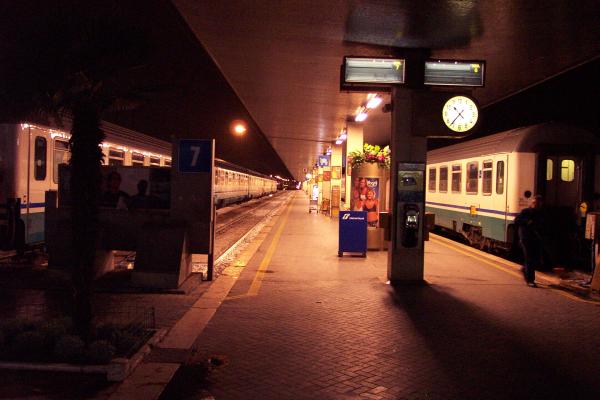
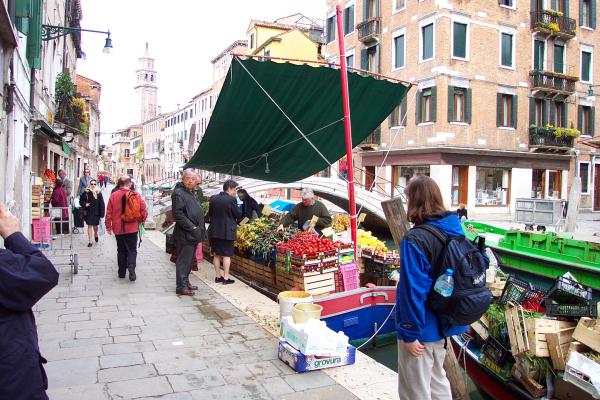
So, wander about we did. My wife loves European farmer's markets. While rambling about
an untouristed neighborhood, we found one, Venetian-style.
Back to Munich.
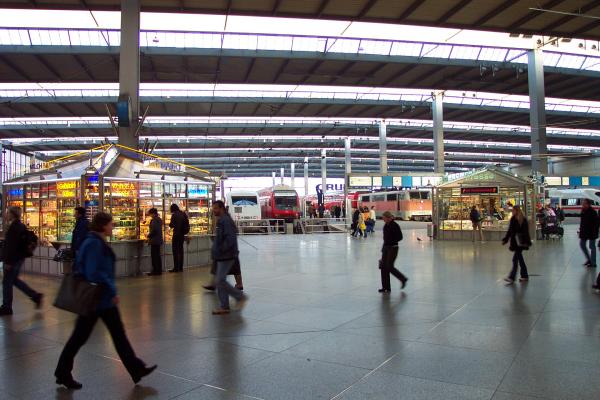
I love Munich. It is probably my favorite city. I feel comfortable there.
And they have a great train station. This is the Hauptbahnhof. It's clean, roomy, and has pretty
good amenities. We got breakfast here, and the bread wasn't the only thing toasted. We took the
overnight train back from Venice, and we didn't get a sleeping cabin. I was up much of the night,
keeping an eye out for thieves and conductors, and then trying to sleep on an uncomfortable
vinyl seat.
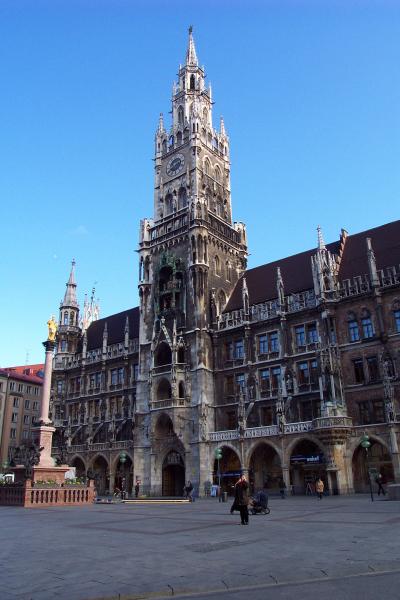
This is Munich's city hall. I believe this, like much of Munich was bombed to rubble in the
second world war. Munich opted to rebuild with the facades matching the old buildings, unlike
Frankfurt, which went all modern. I prefer the old fashioned look.
Anyway, during the day, at noon and 5pm, I believe,
there is a mechanical show in the clock tower, with figurines acting out a joust and the
Cooper's Dance, which was a celebratory dance from medieval times for the passing of the
Black Death.
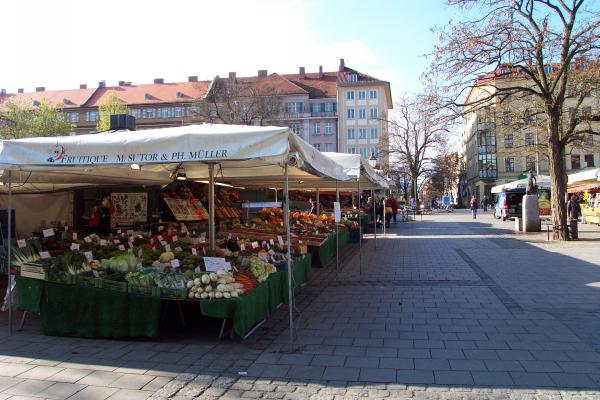
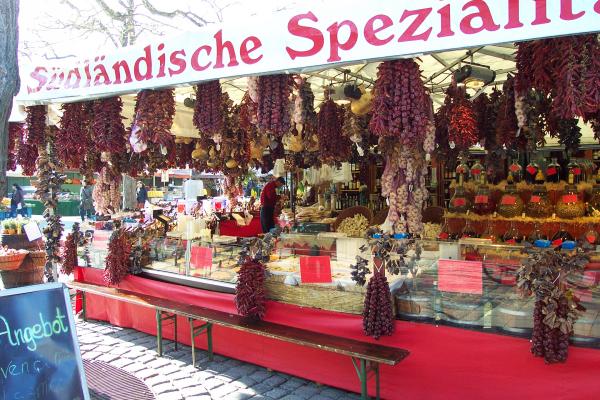
Like I mentioned before, we enjoy finding these farmer's markets. Munich has a fabulous one,
the Viktualienmarkt. Even in the big city, it manages to keep some of the cozy feeling to it.
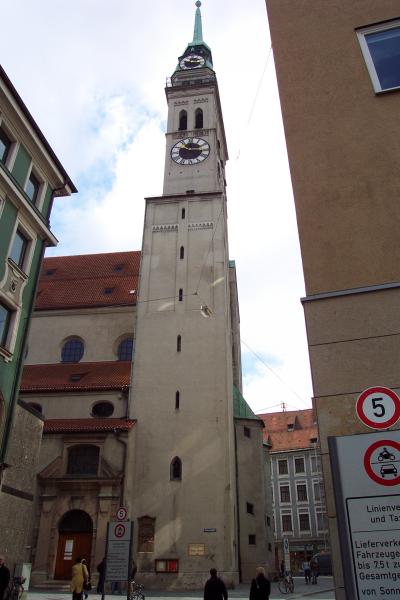
This is a picture of St. Peter's Church, where you can climb many steps to the top
of the spire. It's just off of Marianplatz, so if you're there for the town hall clock show,
might as well climb this too. Great views on a clear day. It can be an arduous climb
up the narrow stairway when there's a mob of people coming back down.
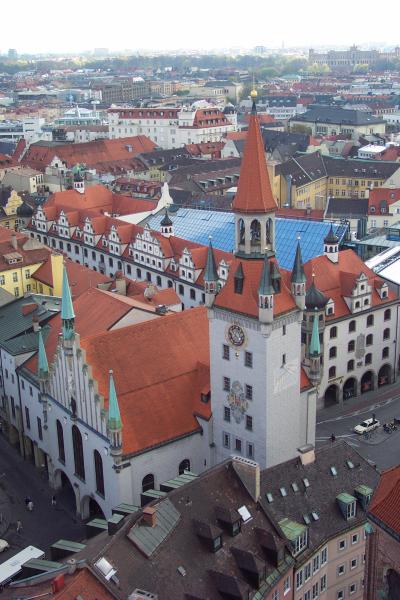
The view from the top of St. Peter's Church of the Alte Rathaus, also rebuilt after the war.
Way in the background is the start of the English Garden, one of Munich's huge open green
areas. Somewhere in between is the building housing the famous Hofbrau Haus. A very
touristy establishment now, but worth one visit. Sing German beer drinking songs with a
bunch of drunk foreigners. It's fun.
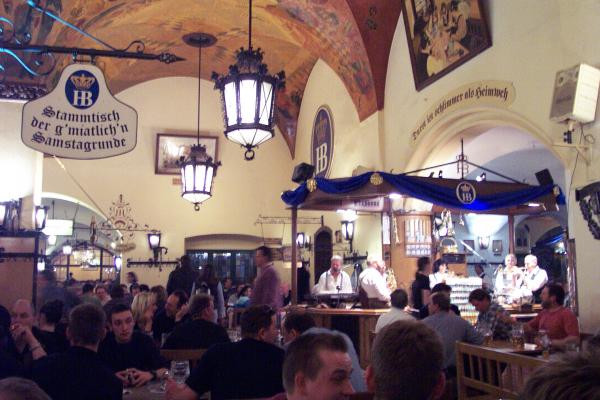
Just don't sit at the Stammtisch. That table is for their "regulars". Not sure who their
regulars might be. Kinda like being a regular at a Hard Rock Cafe. Go there to gawk at
the crowds and tourists, I guess.
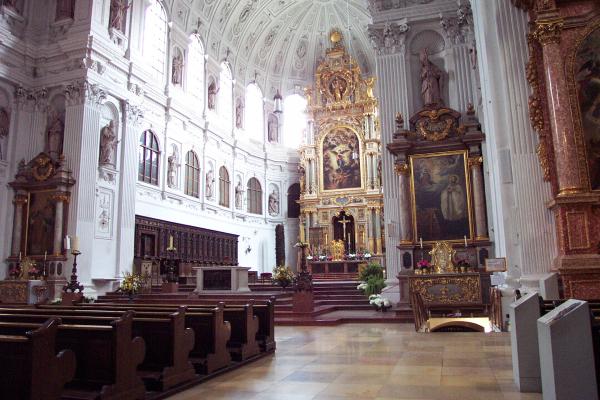
This is the (???) Church. Located in the crypt here are the sarcophagi of many of the Wittelsbach
family. They used to be the royal family of Bavaria. They lost their authority after the
First World War, but I think they are still considered as royalty, if only for marriage purposes
for the few remaining regal bloodlines. Regardless, they still own a bit of property in and
around Bavaria.
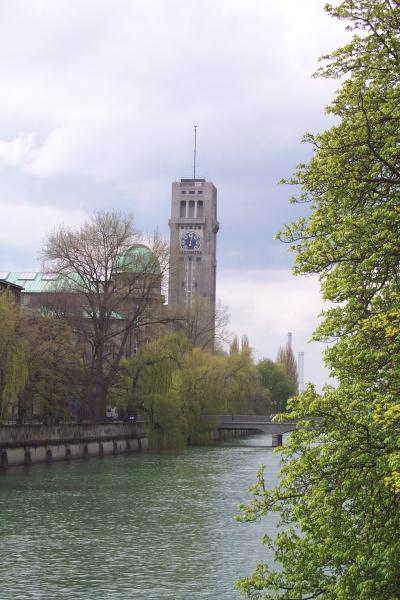
We visited the Deutsches Museum.
This is an incredible museum devoted to technology, and worth an entire day, when one is actually
awake. As previously mentioned, I was toasted from basically being up all night on the
train. This museum resides on an island in the Isar River. It has a huge section on trains,
from a neat model layout to real steam engines, also has a large airplane area, as well as other
exhibits covering the whole spectrum of technologies. Atomic energy. Plastics.
Even a section on making paper, and printing on it.
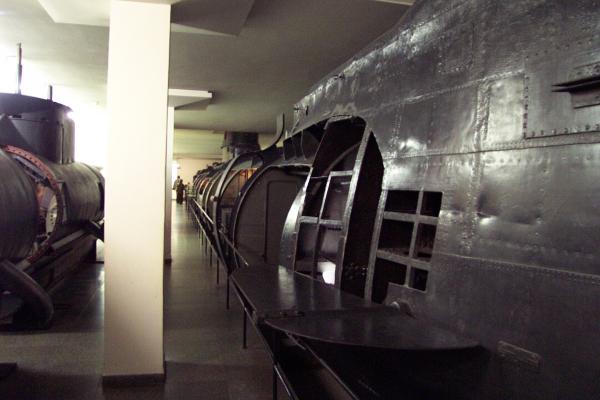
One of the more interesting exhibits, to me, was hidden way in the bowels of the building,
U-1, the prototype submarine from World War One. Germans are sensitive to their recent
military history, so this does not get much advertisement. I had heard that it was here,
but I couldn't find it on the museum map. It's just sitting in the back of the maritime section.
I am not sure how this one
escaped being scraped as part of the disarmement, but here it is, cut away for viewing.
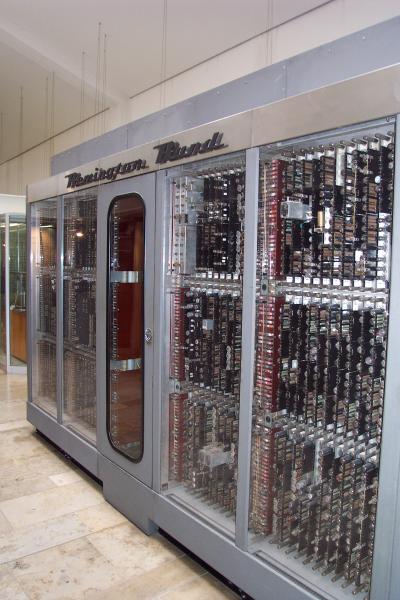
Lots of old computer equipment was here as well. This is a Remington Rand computer, I believe
it's from the late 1940's. Banks of mechanical relays, miles of wiring. A lovely front
door, which one could walk through to access the interior circuits.
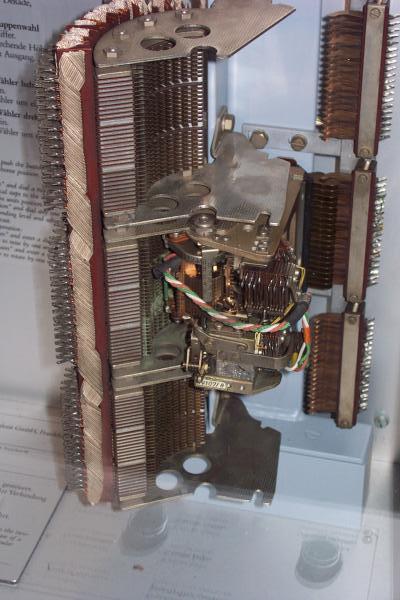
And this is a portion of an electro-mechanical telephone switch. It was part of a fascinating
display on how the telephone system used to work, and interesting to me since I work in
the industry. They had a small working setup, where you dialed a number, and it showed the
relays clicking and clacking to make the appropriate connections. Even had an inter-exchange
example. The telco's central offices must have been very noisy with tens of thousands
of these clattering away.
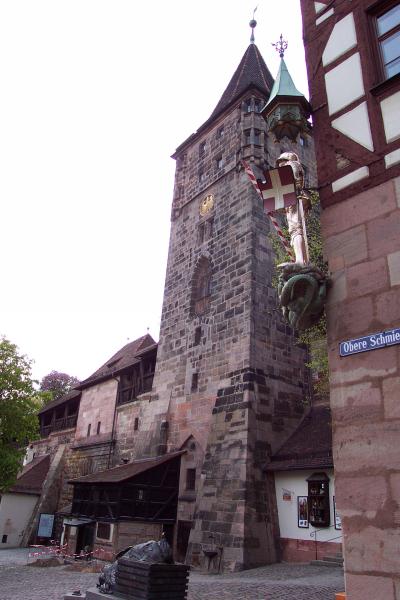
We did manage to see the Kaiserburg Castle, but missed
the last English tour. My German was of no use yet. About the only thing I gleaned from the
tour was that the guide was rather annoyed that the Americans had removed the Holy Roman Emporer's
crown from here and sent it to Vienna, Austria after the war. In truth, Nürnberg had been the seat
of the empire more often than Vienna. Not that the Emporer was there much,
as that job was mostly a travelling road show spent trying to solidify support,
but this was where the Prince Electors came to decide the Emporer, and this
is where the "office" was.
We also managed to see the town dungeons, the Lochgefängnis. Interesting,
damp, and a bit spooky. The guide described the methods used and what crimes
they were associated with. They actually had a legal code detailing what
punishment suited which crimes, so the criminal knew what was in store.
I guess that's better than being subject to the whimsy of the guy in the
black mask.
We didn't have time to see the German Railway
Museum, although as a surprise, we did find an American Flyer model railroad layout on
the top floor of a small toy museum.
It was getting late, and we needed to get going. We were spending the night at the
Ringhotel Schiff am See in Konstanz, on the
Bodensee. The Bodensee is a largish
lake along the German-Swiss border, with it's eastern end being in Austria.
It is fed and drained by the Rhein river, and is a popular vacation destination.
I am told that the most spoken language around the Bodensee in the summer is
Dutch, not German.
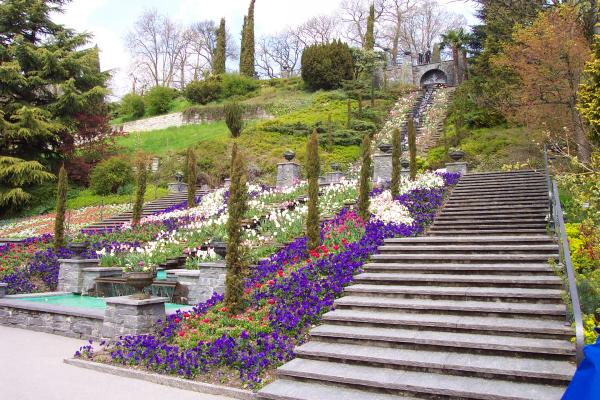
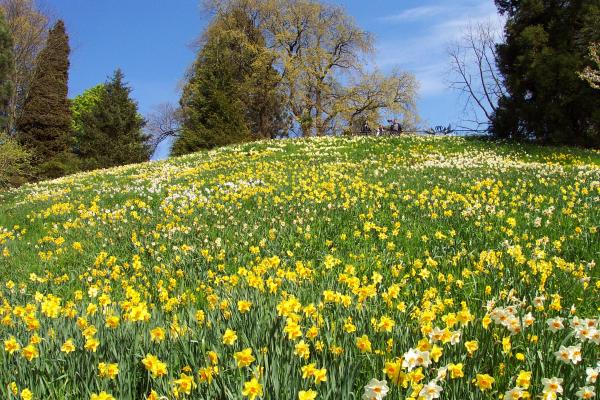
If you like flowers, and it's a nice day during the time of the year when flowers can be
grown outside, pay a visit to Mainau Island
at the western end of the lake. It is a private island owned by a Swedish count with a
passion for flowers, who opens it to the paying public to wander about the many landscaped acres.
I am not really into botany, but I do enjoy strolling about with beautiful scenery to look
at. They claim to have flowers all year round, but I can't imagine what they put out in
January. Like I said, I'm no botanist.
If you are going to spend any time around the Bodensee, including Mainau, get the
Erlebniskarte.
It gives discounted admission to many, many attractions about the Bodensee, and even
on boat rides crossing it. We bought the 7-day pass, even though we were only spending
3 and half days in the area, and we recouped the cost of the card, plus a bunch.
After Mainau, we went into the town of Konstanz. I had been here briefly in
the 1980's, but we were looking for a turn signal relay for our VW bus, and
not sightseeing. There is an aquarium here to visit, but it had closed for
the day just before we got there. So, we just wandered about.
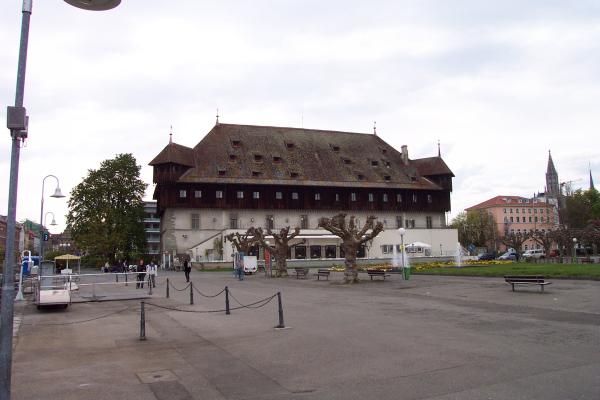
Never, EVER trust a politician.
This is where the
Council of Constance
met in 1414, to deal with issues facing the Roman
Catholic Church at the time, such as "The Extinction of the So-Called Western Schism",
"The Reformation of Ecclesiastical Government and Life", and "The Repression of Heresy".
Czech religious reformist, Jan Hus, who had definite views on some of these matters,
was convinced to attend the Council by King Sigismund, who had personally
assured Hus' safety. The Council, being counter-reformation types, burned Hus at the stake.
Never, EVER trust a politician.
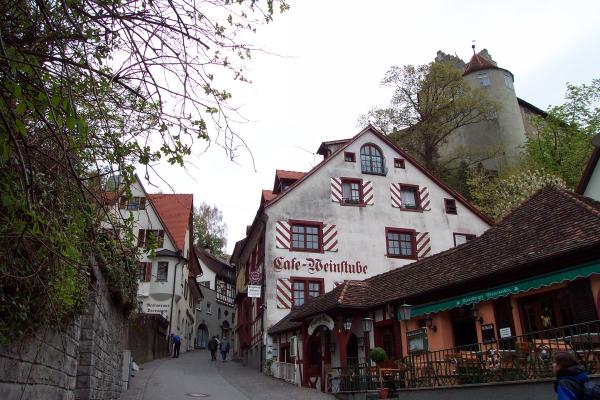
Meersburg is the center of Germany's southernmost wine region. I know
almost nothing about the types of wines produced here, so I wanted to
explore the Weinstuben in Meersburg. That didn't happen. I did briefly
persuse a wine shop, but just couldn't buy anything flavor untasted.
There also was a wine museum in this town, but it wasn't open.
We did take the castle tour, which was somewhat interesting. This is the
oldest intact castle still standing in Germany. There is an armor exhibit, and
a very nice view of the lake from one of the terraces... if the weather is
clear.
We had planned on renting bicycles and riding about the lake shore, but the
weather wasn't that great, and our itinerary was falling apart anyway.
Oh well.
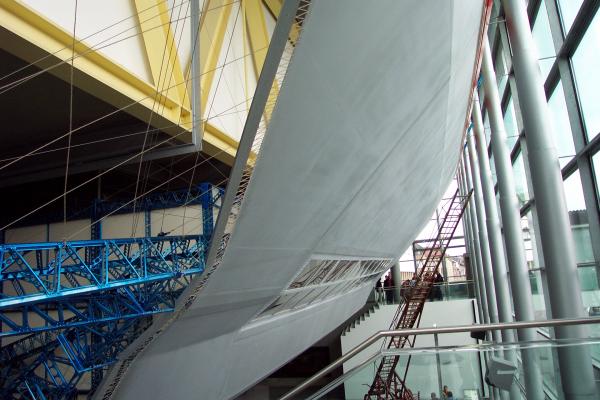
We did, however, make it to the
Zeppelin Museum in Friedrichshafen.
What a cool place. Conveniently located too, between the train station and
the boat harbor. This is a picture of a full scale recreation of a section
of the Hindenburg. Everything and anything you ever wanted to know about
Zeppelins is in this museum, including many models and mechanical parts. They
have a very good, and probably over-detailed, audio handset that you can rent,
which describes what it is you are looking at. Turns out that the father of
someone we know back home was involved in making some of the displays. Next
time, I'll see about getting a picture of some of his work.
It was getting late, and we needed to do laundry. We only brought 1 week's worth of clothes.
We found a Wascherei in Friedrichshafen, and that turned out to be a bit of an adventure.
Trying to figure out the instructions for the equipment was fun. We did get some help
from a friendly lady. In trying to come up with a translation for the spin-dry cycle,
all she could think of was "thrash". So, we ran our clothes through the
thrash cycle.
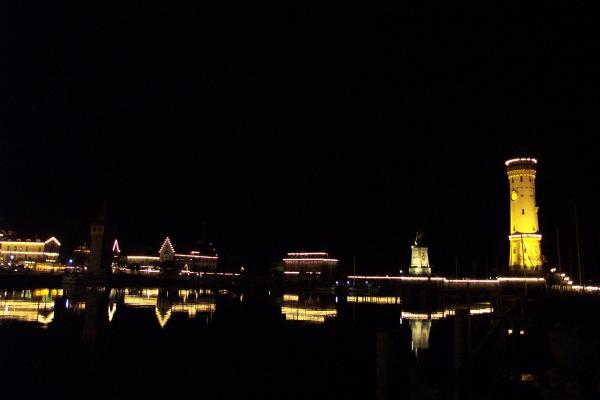
This is a shot of Lindau at night. Lindau is an island-town at the eastern end of
the Bodensee. We stayed at the
Hotel Lindauer Hof. A nice place, located
very close to the harbor. We went down to the bar for a drink late that evening.
I collect the beermats (bierdeckel in German) from places we go, and I asked the lady working there if I
could have one. She brought out an entire pack. I should have taken it, but politely
declined the whole thing, opting for just a few.
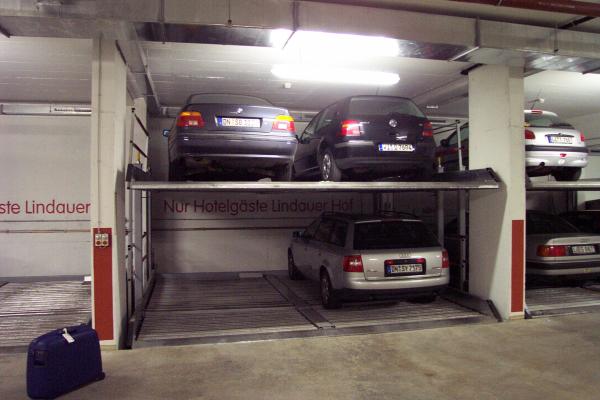
Ok, now this was just cool. We checked into our hotel in Lindau, and they told us to go
park in this garage. Well, when we pulled in, we didn't see any open spots. Starting
to get annoyed at that, we noticed that there were cars underneath, hidden down in the
wells (none of the platforms were raised at the time). Basically, you pushed a button,
and the whole platform would raise, or lower, and then you drove your car onto it.
And that is our Audi A6 Wagon rental on the bottom tier. Nice car, was a pleasure
to drive.

Work in progess
Work in progess